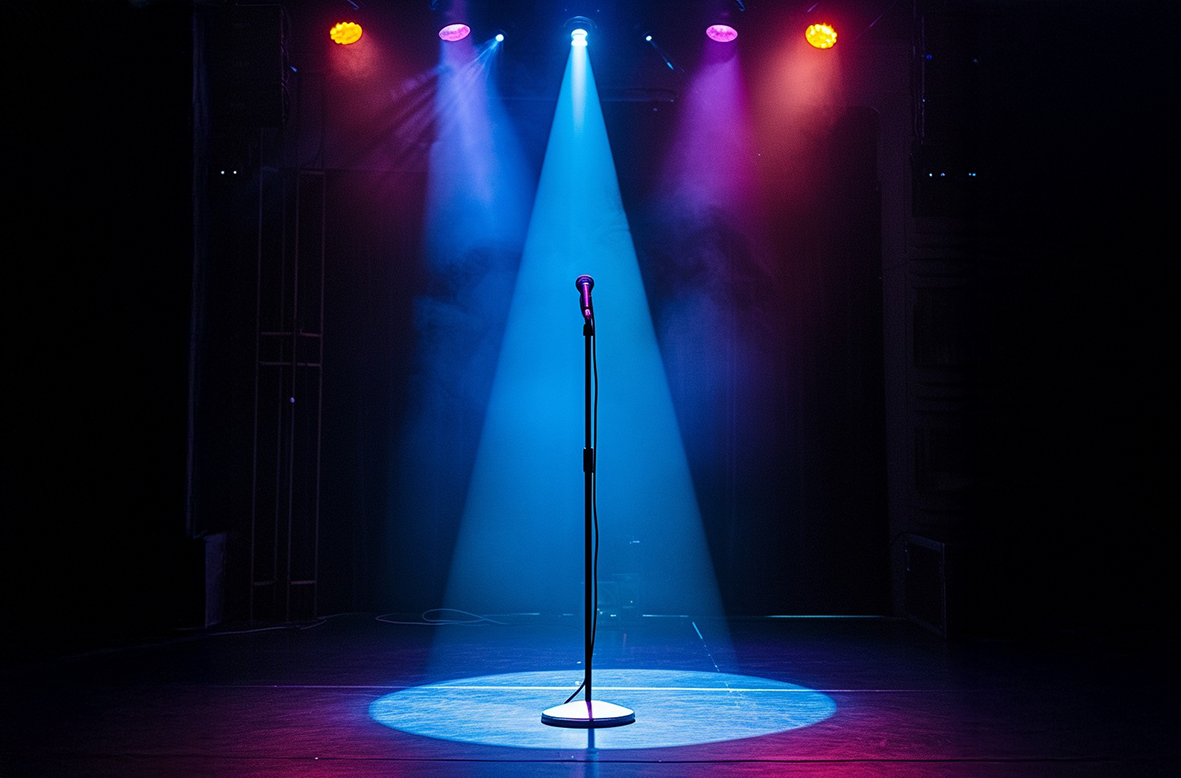
I went out-out for the first time in ages the other night — a phrase that now carries a slight tremor of anticipation and mild dread in me. Into the centre of Manchester I went, not to drink or party or misplace my dignity, but to watch a friend from the AA fellowship take to the stage for a stand-up comedy night. A pub was the venue, of course — because where else would one perform existential hilarity? At this point, you’d be forgiven for raising an eyebrow and muttering, “A pub? Seriously?” And yes, it would be risky — if I’d gone alone. But I didn’t. I rolled in with two solid fellows from the programme, like knights of sobriety braving the dragon’s den, ready to hold each other up should the siren song of beer-slicked coasters and the clink of temptation try to seduce us.
On the way there, I gave one of the lads a lift, and I’m glad I did. The route unintentionally became a scenic tour of my past wreckage. We passed the spot where, in the final year of my drinking, I turned what began as a “nice day out” into a Shakespearean tragedy (without the poetry), ending up in a police cell with a drink-driving charge hanging over my head. Not far from there, the car rolled by the courthouse where I later stood, bewildered and broken, having no recollection of anything past my fourth drink — which, in hindsight, might as well have been my fourteenth. Yet that night, as I drove by these ghosts of my former self, I realised something beautiful: I wasn’t that person anymore. And what lay ahead — a night of sober laughter — reminded me just how far I’d come.
The show itself was unexpectedly profound. While most people in the pub were sipping their pints and chuckling without a second thought, I was watching something deeper unfold. The comedy, though light and breezy on the surface, carried a subtext of experience, strength, and hope. It felt like a secret AA meeting in disguise — a kind of Trojan horse of recovery, sneaking truth into the crowd beneath the cover of a punchline. I couldn’t help but reflect on a recent chat I’d had with my dad, whose presence in my life has often been one of the only stable things in a world I spent years trying to set on fire, along with my mum, obviously.
My dad — he’s a marvel. A man who’s endured cancer (twice), heartbreak, and even a serious house fire, and still manages to smile like he’s just heard the world’s best joke. Emotionally, he’s about as forthcoming as a locked filing cabinet, but he’s always been there: financially, practically, lovingly — even when I didn’t think I deserved any of it. I once asked him how he manages to keep laughing through it all, through life’s absurd and cruel plot twists. It was a sunny afternoon, we were in the garden, and though I wasn’t officially up to Step 9, the conversation unfolded into my first living amend. For the first time, I saw my dad cry — not from pain, but from joy. And then he laughed, that big, booming laugh, the one that seems to come from somewhere deeper than the lungs. I asked him, “How do you stay happy?” His answer was perfect — and somehow, perfectly him.
“Life is a comedy,” he said. “We just have to get the joke, and learn to laugh — mostly at ourselves.”
I didn’t know it at the time, but that moment marked a turning point. I decided, at the grand age of 47, that when I grow up, I want to be just like my dad. Sure, I take my sobriety seriously — life or death, really — but I also now try to take myself a lot less seriously. When life throws its usual nonsense at me — a bad day, a broken boiler, an awkward moment in the supermarket — I don’t spiral anymore. I laugh. I breathe. I handle what needs handling. And then I move on to the next absurd scene in the great stand-up routine that is life. Because really, once you stop trying to control the script and just enjoy the act, it’s actually pretty funny.
The Way of Laughter
I went out-out,
a phrase that quivers now,
with both the eagerness of life,
and the shadow of what once held it hostage.

Not to lose myself,
but to watch a sister,
turn wounds into wit,
sorrow into setup,
a pintless prophet in a pub of pints.

They say, “A pub? Seriously?”
Yes.
But not alone.

Three walked in,
like oaks rooted in the same wind.
We did not flinch at the clink of glass,
the siren scent of old illusions.
Together, we walked upright.

Temptation,
when met with fellowship,
shrinks into a story,
we've already heard too many times.

The journey there,
was a pilgrimage in reverse,
past wreckage,
past memories crusted over with guilt and gasoline.
There was the road,
and the cell,
and the courthouse,
and me,
once split into fragments too scattered to name.

But I looked,
and I did not weep.
I simply saw.
The past had become
a quiet signpost.
It no longer pointed home.

Laughter came.
Not the kind that forgets,
but the kind that forgives.

A room full of strangers,
sipping from their forgetfulness,
never knew the sermon,
hidden in the stand-up set.

It was a meeting without a format.
A share without a timer.
The truth slipped in,
through the back door of a joke,
and sat quietly,
on every table.

And my father,
stoic as winter.
Resilient as stone.
that has learned to sing when struck,
taught me,
the final trick.

“How do you stay happy?”
I asked.
He didn’t pause.
He didn’t sermon.
He smiled
with the kind of smile
you don’t learn, only live.

“Life is a comedy,” he said.
“You just have to get the joke.”

Now,
I don’t spiral.
I orbit.
I circle the chaos with grace,
like a sober dancer,
in a world still sloshed on itself.

When the boiler breaks,
I breathe.
When shame knocks,
I nod,
but I don’t let it in.
When the moment is awkward,
I bow to its absurdity,
and move on.

I used to try to control the script.
Now,
I let the act unfold.

Sobriety is serious.
But the soul?
The soul prefers,
a good punchline.

In the end,
I want to be like my father,
weathered,
weirdly joyful,
and still laughing.

This is the Way.
Not to avoid the storm,
but to walk through it
with a smile
that says,
“I’ve seen worse.”